Parse dateTime 
Compute the sum of 5,000,000 UTC Unix timestamps as fast as possible.
Input
One RFC 3339 datetime per line on STDIN:
2017-05-04T14:31:30-03:00
2046-06-23T11:51:56-06:00
2031-08-14T13:18:38+06:00
2048-04-14T05:55:06-09:00
1980-08-28T00:43:03+02:00
Output
Print the sum of all UTC Unix timestamps (int64) to STDOUT.
Constraints
- Datetimes are in the range
1950-01-01T00:00:00to2050-12-31T23:59:59
CPU Information
| Model | Intel(R) Xeon(R) CPU E3-1271 v3 @ 3.60GHz |
| Cores | 1 |
Extensions
Installed Packages
| Name | Version | Description |
|---|---|---|
| libc6-dev | 2.39-0ubuntu8.7 | GNU C Library: Development Libraries and Header Files Contains the symlinks, headers, and object files needed to compile and link programs which use the standard C library. |
| libclang-common-14-dev | 1:14.0.6-19build4 | Clang library - Common development package Clang project is a C, C++, Objective C and Objective C++ front-end based on the LLVM compiler. Its goal is to offer a replacement to the GNU Compiler Collection (GCC). . Clang implements all of the ISO C++ 1998, 11, 14 and 17 standards and also provides most of the support of C++20. . This package contains the Clang generic headers. |
| libclang-common-15-dev | 1:15.0.7-14build3 | Clang library - Common development package Clang project is a C, C++, Objective C and Objective C++ front-end based on the LLVM compiler. Its goal is to offer a replacement to the GNU Compiler Collection (GCC). . Clang implements all of the ISO C++ 1998, 11, 14 and 17 standards and also provides most of the support of C++20. . This package contains the Clang generic headers. |
| libclang-common-16-dev | 1:16.0.6-23ubuntu4 | Clang library - Common development package Clang project is a C, C++, Objective C and Objective C++ front-end based on the LLVM compiler. Its goal is to offer a replacement to the GNU Compiler Collection (GCC). . Clang implements all of the ISO C++ 1998, 11, 14 and 17 standards and also provides most of the support of C++20. . This package contains the Clang generic headers. |
| libclang-common-17-dev | 1:17.0.6-9ubuntu1 | Clang library - Common development package Clang project is a C, C++, Objective C and Objective C++ front-end based on the LLVM compiler. Its goal is to offer a replacement to the GNU Compiler Collection (GCC). . Clang implements all of the ISO C++ 1998, 11, 14 and 17 standards and also provides most of the support of C++20. . This package contains the Clang generic headers. |
| libclang-common-18-dev | 1:18.1.3-1ubuntu1 | Clang library - Common development package Clang project is a C, C++, Objective C and Objective C++ front-end based on the LLVM compiler. Its goal is to offer a replacement to the GNU Compiler Collection (GCC). . Clang implements all of the ISO C++ 1998, 11, 14 and 17 standards and also provides most of the support of C++20. . This package contains the Clang generic headers. |
| libclang-common-19-dev | 1:19.1.1-1ubuntu1~24.04.2 | Clang library - Common development package Clang project is a C, C++, Objective C and Objective C++ front-end based on the LLVM compiler. Its goal is to offer a replacement to the GNU Compiler Collection (GCC). . Clang implements all of the ISO C++ 1998, 11, 14 and 17 standards and also provides most of the support of C++20. . This package contains the Clang generic headers. |
| libclang-common-20-dev | 1:20.1.2-0ubuntu1~24.04.2 | Clang library - Common development package Clang project is a C, C++, Objective C and Objective C++ front-end based on the LLVM compiler. Its goal is to offer a replacement to the GNU Compiler Collection (GCC). . Clang implements all of the ISO C++ 1998, 11, 14 and 17 standards and also provides most of the support of C++20. . This package contains the Clang generic headers. |
| libcrypt-dev | 1:4.4.36-4build1 | libcrypt development files This package contains the files needed for developing applications that use libcrypt. |
| libgcc-10-dev | 10.5.0-4ubuntu2.1 | GCC support library (development files) This package contains the headers and static library files necessary for building C programs which use libgcc, libgomp, libquadmath, libssp or libitm. |
| libgcc-11-dev | 11.5.0-1ubuntu1~24.04.1 | GCC support library (development files) This package contains the headers and static library files necessary for building C programs which use libgcc, libgomp, libquadmath, libssp or libitm. |
| libgcc-12-dev | 12.4.0-2ubuntu1~24.04.1 | GCC support library (development files) This package contains the headers and static library files necessary for building C programs which use libgcc, libgomp, libquadmath, libssp or libitm. |
| libgcc-13-dev | 13.3.0-6ubuntu2~24.04.1 | GCC support library (development files) This package contains the headers and static library files necessary for building C programs which use libgcc, libgomp, libquadmath, libssp or libitm. |
| libgcc-14-dev | 14.2.0-4ubuntu2~24.04.1 | GCC support library (development files) This package contains the headers and static library files necessary for building C programs which use libgcc, libgomp, libquadmath, libssp or libitm. |
| libobjc-13-dev | 13.3.0-6ubuntu2~24.04.1 | Runtime library for GNU Objective-C applications (development files) This package contains the headers and static library files needed to build GNU ObjC applications. |
| libssl-dev | 3.0.13-0ubuntu3.9 | Secure Sockets Layer toolkit - development files This package is part of the OpenSSL project's implementation of the SSL and TLS cryptographic protocols for secure communication over the Internet. . It contains development libraries, header files, and manpages for libssl and libcrypto. |
| libstdc++-10-dev | 10.5.0-4ubuntu2.1 | GNU Standard C++ Library v3 (development files) This package contains the headers and static library files necessary for building C++ programs which use libstdc++. . libstdc++-v3 is a complete rewrite from the previous libstdc++-v2, which was included up to g++-2.95. The first version of libstdc++-v3 appeared in g++-3.0. |
| libstdc++-11-dev | 11.5.0-1ubuntu1~24.04.1 | GNU Standard C++ Library v3 (development files) This package contains the headers and static library files necessary for building C++ programs which use libstdc++. . libstdc++-v3 is a complete rewrite from the previous libstdc++-v2, which was included up to g++-2.95. The first version of libstdc++-v3 appeared in g++-3.0. |
| libstdc++-12-dev | 12.4.0-2ubuntu1~24.04.1 | GNU Standard C++ Library v3 (development files) This package contains the headers and static library files necessary for building C++ programs which use libstdc++. . libstdc++-v3 is a complete rewrite from the previous libstdc++-v2, which was included up to g++-2.95. The first version of libstdc++-v3 appeared in g++-3.0. |
| libstdc++-13-dev | 13.3.0-6ubuntu2~24.04.1 | GNU Standard C++ Library v3 (development files) This package contains the headers and static library files necessary for building C++ programs which use libstdc++. . libstdc++-v3 is a complete rewrite from the previous libstdc++-v2, which was included up to g++-2.95. The first version of libstdc++-v3 appeared in g++-3.0. |
| libstdc++-14-dev | 14.2.0-4ubuntu2~24.04.1 | GNU Standard C++ Library v3 (development files) This package contains the headers and static library files necessary for building C++ programs which use libstdc++. . libstdc++-v3 is a complete rewrite from the previous libstdc++-v2, which was included up to g++-2.95. The first version of libstdc++-v3 appeared in g++-3.0. |
| libtbb-dev | 2021.11.0-2ubuntu2 | parallelism library for C++ - development files TBB is a library that helps you leverage multi-core processor performance without having to be a threading expert. It represents a higher-level, task-based parallelism that abstracts platform details and threading mechanism for performance and scalability. . (Note: if you are a user of the i386 architecture, i.e., 32-bit Intel or compatible hardware, this package only supports Pentium4-compatible and higher processors.) . This package includes the TBB development files. |
A generator is a program that produces test data and expected results for a challenge. Each time a solution is checked, the generator runs fresh - producing unique, unpredictable input.
Custom generators let you challenge other participants' solutions with your own test cases. If someone's solution fails on your generator's input, it exposes weaknesses in their approach. Writing good generators requires deep understanding of the problem - you need to craft edge cases, stress tests, and tricky inputs that push solutions to their limits.
How Generators Work
Architecture
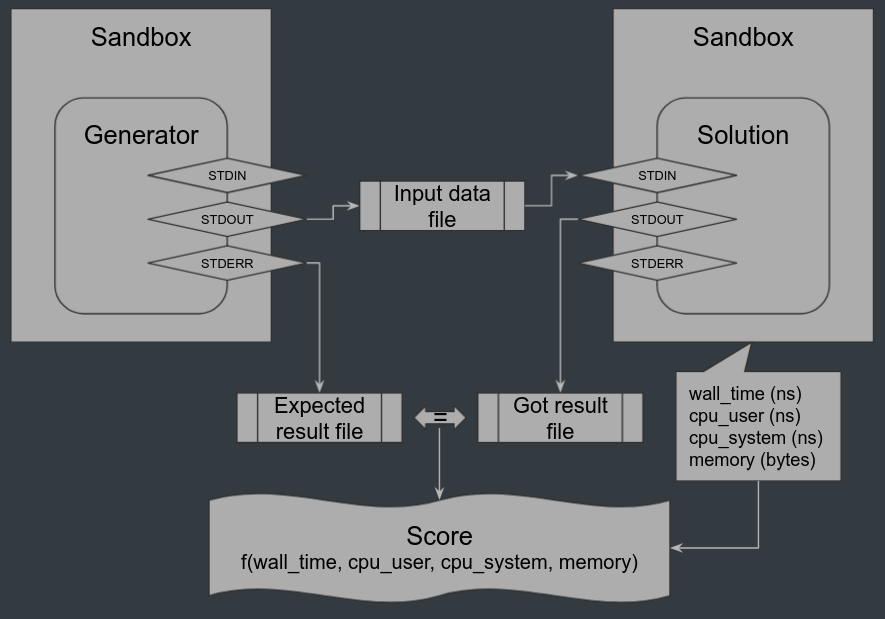
Communication Protocol
| Step | What happens | Channel |
|---|---|---|
| 1 | Generator writes input data | stdout |
| 2 | Generator writes expected result | stderr |
| 3 | Solution receives input data | stdin |
| 4 | Solution writes its answer | stdout |
| 5 | System compares generator's stderr with solution's stdout |
Generated Data Must Match the Task Description
Your generator's output must strictly follow the task specification: data size, format, number of elements, value ranges (min/max), delimiters, and any other constraints described in the challenge. Generators that produce data deviating from the specification will be rejected during validation - boilerplate solutions verify input correctness.
Generator Requirements
- Must produce non-empty
stdout(input data for solutions) - Must produce non-empty
stderr(expected result for comparison) - Must exit with code 0 - non-zero exit is treated as an error
- Runs in a sandbox with no network access
- Subject to the configured memory limit and timeout
- Runs 3 times per check - must produce fresh random data each time
- All provided boilerplate solutions must pass all checks before the generator is accepted